



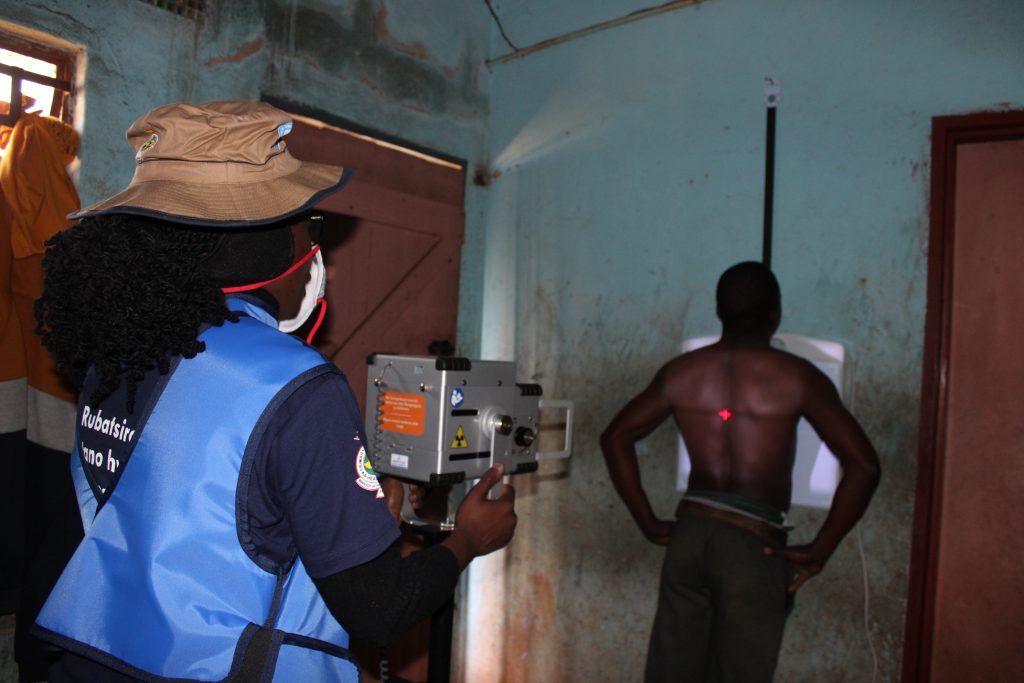
Win Moyo (37) of Chizungu in Mberengwa has been a miner for the past 8 years, currently he is working at Knott Cattle Mine in the same district. He joins other miners at a queue that is swelling fast at Vanguard Business Centre on a cloudy winter afternoon. Win, like the rest of the miners at the queue has braved the cold, drizzling afternoon to be screened for TB and Silicosis, during an outreach stationed at the business centre.

Vanguard is a small disused asbestos mining compound in Mberengwa District, which is now home to artisanal miners. The community does not have any health facilities or other social amenities. They access health services at Mberengwa District Hospital, nearly 15km away.
As the queue moves, Win says, “In all my years as a miner, this is my first time to be screened. I am not nervous but curious to know where I stand, because as a miner – the little knowledge that I have tells me that I fall within the group of people who are at a high risk of developing TB.”

The Union Zimbabwe Trust (UZT), with funding from the Stop TB Partnership, recently launched an innovative TB screening outreach project to promote early detection and treatment in high-risk artisanal mining communities of Mberengwa and Zvishavane districts. The project targets miners like Win and other people residing in mining communities.
Using a mobile model approach, the project employs portable sensitive TB screening methods using an ultra-portable digital x-ray enabled with CAD-AI (Computer Aided Diagnosis – Artificial Intelligence) that allows Win and several other clients to have ‘real-time’ interpretation of clients’ x-ray images for abnormalities suggestive of TB and Silicosis. Rapid, field specimen testing for diagnosis, is also part of the project as well as integrated service delivery for other conditions like Silicosis, malnutrition and alcohol-use disorders.

The project is being implemented in two districts of Midlands province—Mberengwa and Zvishavane—selected due to their high TB burden and significant artisanal and small-scale mining activities.
“My father was also a miner but we never had ‘the talk’, we never received any health education,” Win reveals with a shy look.
“He only told me that I needed to be careful, but in mining – what does that even mean? I know that we have to wear masks to protect ourselves but we don’t often have these, so we improvise by using cloths to cover our mouths and noses. We do not even know which masks we are supposed to use. We have been taught, by miners before us that, a miner drinks fresh milk at the end of a working day to dissolve the dust inhaled.”
Miners being screened during the outreaches are receiving free health education that debunks the “cloth and milk” theory. Occupational health personnel are clarifying that drinking milk and using a mutton cloth as a mask does not prevent miners from inhaling the silica dust that causes Silicosis.

UZT Executive Director, Dr Ronald Ncube says, traditionally, TB screening has relied heavily on passive case finding where individuals with symptoms voluntarily present themselves at health facilities for diagnosis and treatment, an approach that often misses high-risk populations who face barriers to accessing care, such as artisanal miners, people in remote communities, or individuals struggling with co-morbid conditions like alcohol use disorders or malnutrition.
“What sets this model apart, is its integration of TB screening with services for silicosis, malnutrition, and alcohol use disorders, offering comprehensive care closer to where people live and work. By shifting from a passive, facility-based and disease-specific model to a proactive, integrated, and community-focused approach, the project is designed to catch more cases earlier and improve linkage to timely and appropriate care,” he says.

Win says he is grateful for the project, for coming closer to their places of work.
“As a miner, I am aware that I need to be screened for TB but such opportunities have never arisen, and I cannot afford to have an x-ray taken or sometimes we are too busy and never have the time to visit a health facility,” he says
“We have to take advantage of these free services, I am excited that I will have access to an x-ray today. We also want to use this opportunity to learn as much as we can on issues like, what happens if I test positive for TB? How do we keep ourselves safe and how do we adequately use personal protective clothing, we are miners but we have no knowledge on what is supposed to be basic information?”

Screening outreaches will be conducted at artisanal small-scale miners (ASM)’s workplaces during daytime and at social drinking points during evenings (moonlight screening), complemented by enhanced routine community screening by trained community health workers. Additionally, screening will be done at primary healthcare facilities where access to X-ray services is currently limited.
“We are here to launch a game changer project in the diagnosis of TB and Silicosis particularly in settings like these mining communities targeting artisanal miners and ex-miners,” said Dr Mary Muchekeza, Midlands Provincial Medical Director, speaking at the inaugural screening outreach at Vanguard Business Centre.
“I am aware that, as miners you are very busy – that is why we have come to you, with an x-ray and if you are asked to submit sputum for testing, it will be done here. This reduces the amount of time people previously had to endure, thus, ensuring people get treatment and care much faster.”
For Win, other miners and the communities in the two districts, the project is indeed a ‘game changer’ as it has brought the services closer to the point of need.