



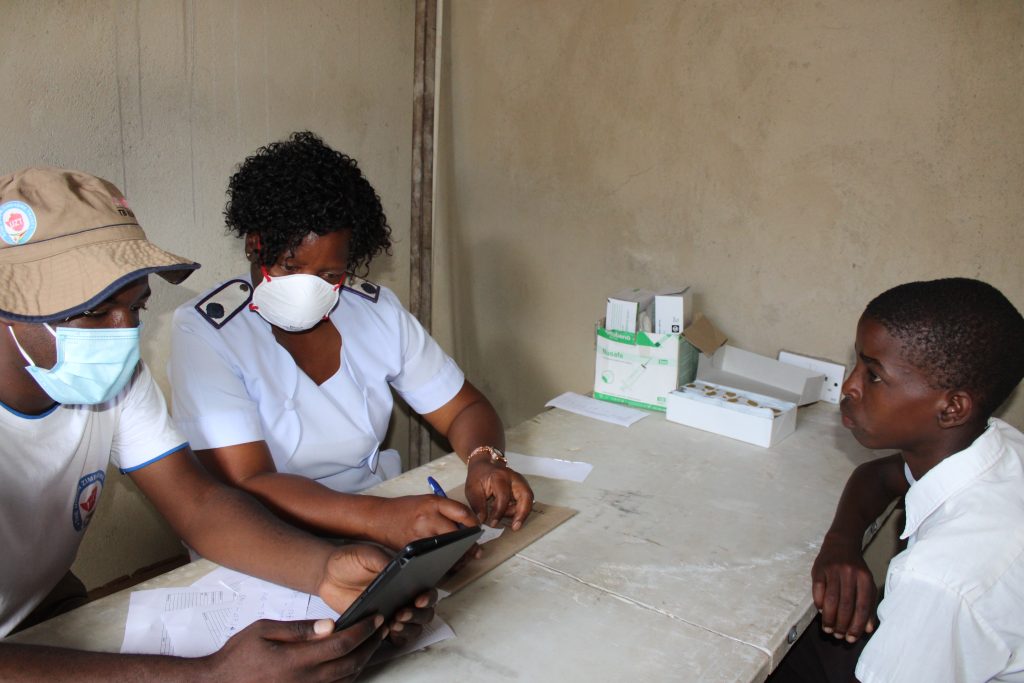
The sun hangs heavy over Muchingwe Business Centre, casting a relentless glare on the Zvishavane District. It is just after midday, and the heat is stifling, yet the queue stretching across the dusty ground remains steady. Among those down the queue is 17-year-old Lemson Mhazo, a young student with his mother, having been pulled from his high school classes for the day. He has been coughing since the previous school term, a lingering ailment that has seen him lose weight and suffer through feverish nights.
“We have been to the clinic twice, but there hasn’t been any improvement,” his mother says, her voice tinged with the exhaustion of a parent watching a child fade. “Hearing that there would be an X-ray machine here today is why we came.”
Because his symptoms are highly suggestive of TB, Lemson is fast-tracked. He is sent for an X-ray and asked to provide a sputum specimen for analysis. For Lemson and his mother, this mobile unit represents more than just a medical check-up – it represents a definitive path toward recovery.

Between July 2025 and February 2026, a mobile outreach project has transformed the healthcare landscape of Mberengwa and Zvishavane districts, in as far as TB is concerned. The TB screening outreach at Muchingwe is a life-saving intervention being implemented by the Union Zimbabwe Trust in support of the Ministry of Health and Child Care and funded by the Stop TB Partnership.
The project uses ultra-portable X-ray technology to bring diagnostic services directly to high-risk artisanal mining communities in Mberengwa and Zvishavane. By closing the physical gap between patients and healthcare, the initiative aims to reduce mortality through early detection and immediate treatment. By meeting people at the “point of need,” the program has screened thousands of residents who might otherwise have gone undiagnosed. Lemson’s journey of hope is not an isolated incident but part of a broader effort to ensure that in the heart of Zimbabwe’s mining districts, no one is left to fight for their breath in the dark.
The true impact of the mobile TB screening initiative in Mberengwa and Zvishavane is measured not just in statistics, but in the lives reclaimed from a silent, airborne threat. In these sprawling mining districts, where the geography of the landscape and the demands of artisanal labor often create barriers to healthcare, UZT and MoHCC have effectively moved the hospital to the people. By deploying ultra-portable X-ray technology directly into the heart of these communities, the project eliminates the costly and often prohibitive travel distances that prevent early diagnosis. For residents like Lemson, these outreaches represent a critical intervention point that bridges the gap between suffering in silence and accessing a definitive clinical pathway.