



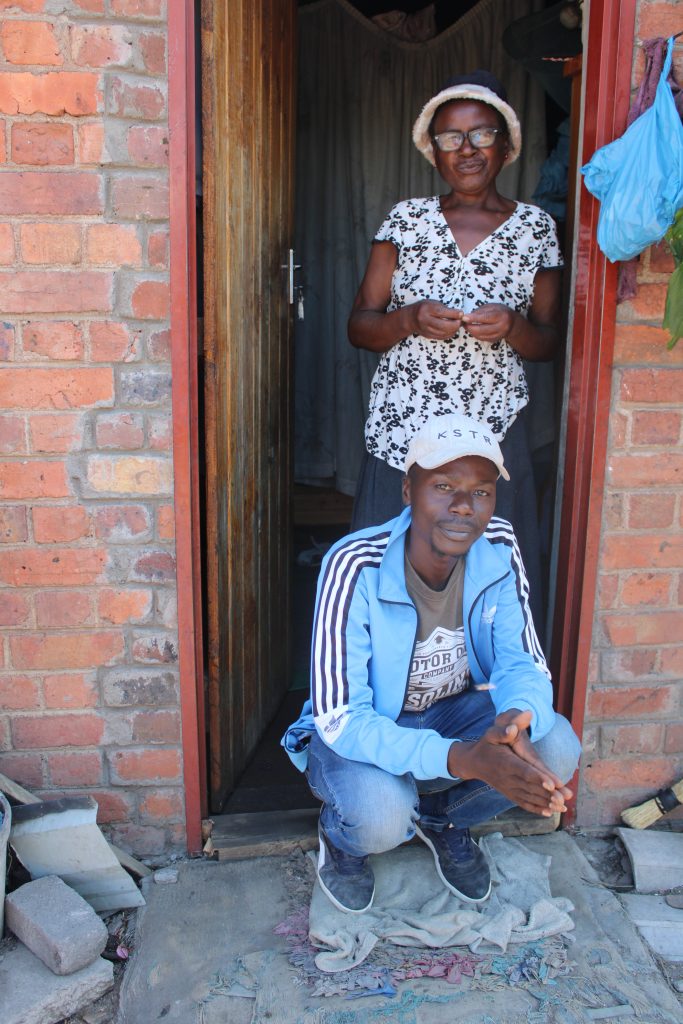
Joel Nyauyanga (35) of Gweru District was devastated when he was diagnosed with Drug Resistant TB (DR-TB). He felt that he was ‘too young’ to be experiencing and dealing with such a condition.
A husband and father to an infant, Joel fell in while in Cape Town, South Africa, where he works in 2022. He experienced difficulty in breathing and was coughing a lot, when he sought assistance at a public hospital in South Africa, he was told that everything was fine, he just needed to rest.
“I went back home but there was no improvement – I did not get any better and those around me insisted it was just a bad flu that would eventually go away. I decide to go to a private health facility where I was informed that I needed to be operated on. That was going to be a huge step and I made up my mind to come back to Zimbabwe to my parents.”
Joel made the long journey back so that his parents could take care of him because he was seriously ill.
His parents live in a one roomed house that is subdivided by curtains; the room is in a backyard that houses a scrapyard business in an industrial location. Two days after his arrival, his parents took him to a local clinic where investigations led to the diagnosis of DR-TB.
“I was relieved when I was diagnosed with DR-TB, but I was surprised because when I was in South Africa – several tests were conducted but none had picked up that I had TB. I was initiated on treatment immediately and I was anxious about whether I would get better.”

“Life after the diagnosis has been difficult because of the expenses we have been incurring, while I appreciate that the treatment is free, there are other costs such as transport and food. My parents are already struggling, so providing adequate food for a recovering patient like me has not been easy.”
Joel represents several other DR-TB patients who face catastrophic costs during their treatment journey. In Zimbabwe, patients and families incur challenging costs while seeking and receiving treatment for TB, and these costs are significantly higher for patients diagnosed with DR-TB.
According to health experts, failure to meet these costs may negatively affect treatment outcome. In some instances, DR-TB can alter life experiences, as with Joel who had to stop working due to illness.
The Stop TB Partnership, through the Union Zimbabwe Trust, and the Ministry of Health and Child Care (MOHCC) under the TB REACH Wave 9 project has stepped in to respond with food support to improve treatment adherence and support. During the project, DR-TB patients received nutritional support through provision of food hampers to mitigate catastrophic costs and promote treatment adherence.
“I am grateful for the food that we received. It has complemented the medication that I have been getting from the clinic. The food support has made it easier for my mother, my primary caregiver to provide adequate care for me – she does not have to worry about looking for food for now.”
The food hamper designed by the MOHCC Nutrition Department consisted of a 10kg mealie-meal, 2litres cooking oil, 2kg sugar, 1kg beans, 1kg peanut butter and 2kg soya chunks. Nutritional support was provided to DR-TB patients for the duration of their treatment, and at the end of the project 590 food hampers had been distributed to DR-TB patients across 19 project districts in Bulawayo, Matebeleland South and Midlands provinces.