



For Tafadzwa Shumba, an artisanal miner in Zvishavane District, accessing healthcare services, especially chest x-ray for TB screening has never been easy. Working in a mine, a perfect breeding environment for tuberculosis (TB), Tafadzwa is at increased risk of developing TB or Silicosis. While he is aware of the need for regular check-ups including screening for TB, his access to health care at the closest facility is compromised by lack of financial and time resources.
Tafadzwa says the nature of their work does not allow them to miss work at the pits and ultimately visiting a health facility is a ‘luxury’ that one cannot afford.
“If I miss a day’s work, I miss on a day’s earnings. Visiting a health facility requires money for transport and X-ray costs – these are costs that most artisanal miners cannot afford,” Tafadzwa says.
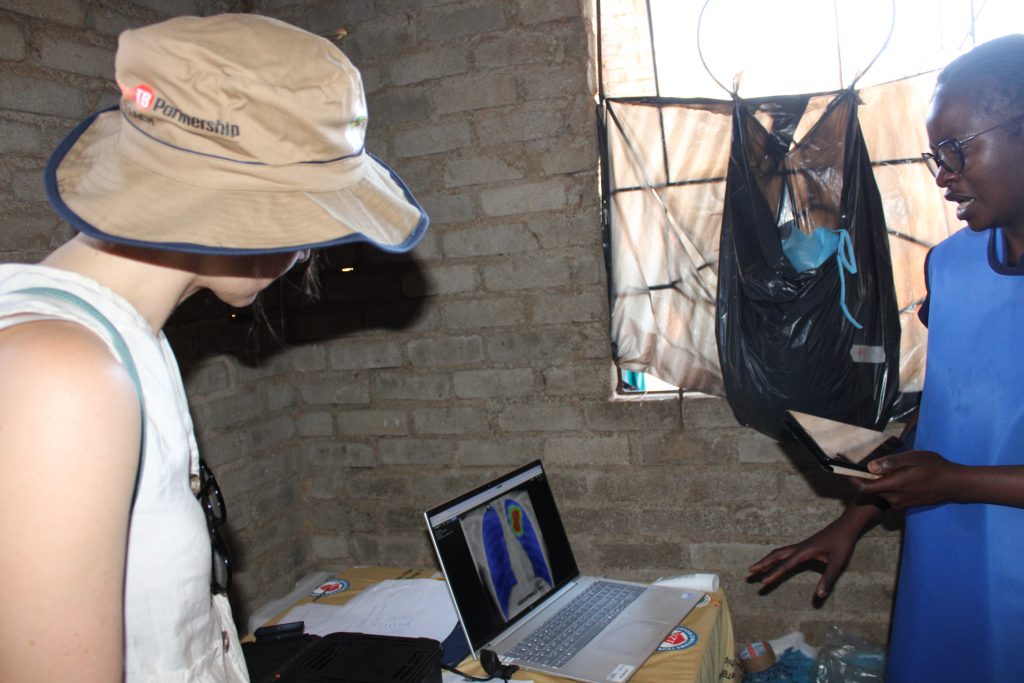
The Union Zimbabwe Trust (UZT), supporting the Ministry of Health and Child Care (MoHCC), is implementing a Stop TB Partnership-funded project which is closing the gap by taking ultra-portable X-rays closer to the point of need, to the mining communities to screen for TB and Silicosis. The innovative outreach project aims to reduce deaths and illness due to TB and other lung conditions by promoting early detection and treatment in high-risk artisanal mining communities of Mberengwa and Zvishavane.
The project, using a mobile screening model approach, provides portable sensitive TB screening methods using ultra-portable (light device that can be carried by a single person) digital X-ray enabled with CAD-AI (computer-aided diagnosis using AI) that allows real-time interpretation of clients’ chest x-ray images for abnormalities suggestive of TB and Silicosis.

Zvishavane District TB Coordinator, Nkulumo Ncube says the project has added value to the district’s TB case finding, through screening outreaches at the mining sites where artisanal miners like Tafadzwa can easily access TB services, free of charge.
“The project’s portable X-ray has improved our presumption rate, as the accompanying AI software (CAD-AI) is picking potential TB clients by giving a high score of above 50 which eventually pushes presumption. The X-ray is also enabling the district to double diagnose – TB and Silicosis under one roof,” Ncube says.
A chest X-ray is considered the best screening tool for TB when sensitivity is compared to symptom screening.
“Zvishavane District is a TB burdened district, with a lot of small-scale mining activities. Since the mobile outreaches started, we have managed to diagnose 43 TB cases between July and December 2025.”
UZT Radiographer, Michelle Madzudzo says the artificial intelligence software allows for the quick processing of X-ray images. This is because it enabled detection of abnormal images by means of a scoring system between 0 and 100, to be successfully done in the field.
The screening outreaches which started in July 2025 have so far screened a total 3,991 people across Mberengwa and Zvishavane districts with a total of 89 all forms of TB cases and 56 Silicosis cases being diagnosed.

Ncube also adds that the ultra-portable X-ray being used for the mobile screening outreaches, “removes the burden of transport and service costs,” for clients seeking screening services.
The Global TB Report 2025 highlights that one of the barriers to accessing TB diagnosis and treatment is the costs faced by people with TB and their households, with Zimbabwe having about 80% facing costs that exceed 20% of annual household income. Reducing this economic burden requires innovation and a faster progress towards Universal Health Coverage (UHC) with better levels of social protection.”