



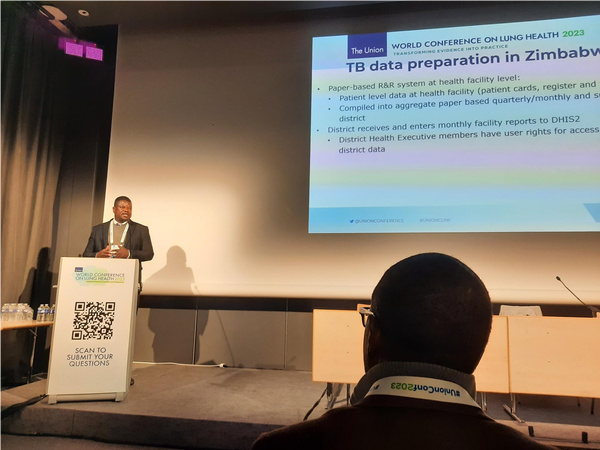
The Union Zimbabwe Trust (UZT) and National TB Control Program were key faculty members that facilitated a post-graduate course (PGC), TBData4Action in One Day, at the recent Union World Conference on Lung Health 2023 in Paris. The course promotes systematic use of routine data for quality improvement in TB prevention, case finding and case holding. It was attended by 33 delegates from across the globe namely, Zimbabwe, Zambia, United States of America (USA), Chad, Kenya, Togo, Jordan, Mozambique, Belgium, India, Benin, Indonesia, Kyrgyzstan, Ethiopia, Guinea, Tanzania and Cameroon.
For over 100 years, The Union World Conference on Lung Health has brought together Scientists from across the globe to present the latest scientific research in all aspects of lung health. In the opening session, Professor Guy Marks, the current Union President applauded the global TB community for the remarkable milestone of 7.5 million people diagnosed with TB in 2022, the highest ever reported since 1995 when the 1st issue of the Global TB Report was published. He however cautioned that if the world is to achieve the fast-approaching 2030 End TB targets, there must be deliberate investment in “more accurate tests, effective and safer medicines and vaccines, as well as optimizing existing tools.”
The PGC is based on a guide that The Union and NTP developed and piloted in Zimbabwe with the support of the United States Agency for International Development through TBCARE I. The objective of the course was to introduce a simple and user-friendly approach on how health staff and managers at facility, district and higher levels can tabulate and analyse their own routine TB data for management and decision making. Key indicators covering the main components of TB programme are compared with expected values to identify strengths and challenges, and to agree on action points to address such challenges. The approach is implemented through data-driven supportive supervision, using check lists and performance review meetings. Participants learnt the importance of collecting quality data and acquired skills in data tabulation and analysis through field case studies discussed during group work and plenary sessions.
The approach strengthens implementation at facility level where TB patients are increasingly being diagnosed and treated, and district level which monitors a network of facilities, identifying “hot” and “cold” spots where early case detection should be strengthened. The approach makes local staff more motivated to own their data, and also enhances data quality, the content of supervision, follow-up training and ultimately, patient care.
The course has been a prominent feature at previous World Lung Conferences since 2015. As a ripple effect, nine countries across Africa and beyond have since adapted the concept. During the course, African Francophone countries shared their progress and experience in institutionalizing principles taught through the course in their local context.
The UZT through Kunda-Nqob’iTB is in the process of consolidating gains in rolling out the course to all project districts. To date, seven out of the eight project districts have been trained and mentored at district and facility level.
In addition to the post-graduate course, the KN-TB project was also represented by Professor Dingani Moyo under ECSA-HC with a satellite session under Information systems for TB, programme monitoring and TB surveillance. He presented on Lessons from developing and implementing a Cross-Border Referral System contributing to ending TB in mining sector in southern Africa