



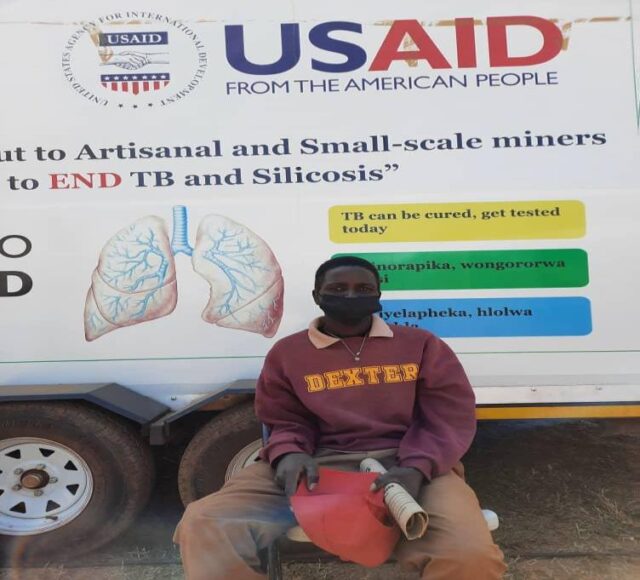
From the dusty streets of Shurugwi town, one cannot fail but notice the hype of artisanal and small-scale miners carrying their tools of trade and covered in their dusty brown work attires, trudging on in the thick bushes in a frenzy hunt for the famous metal, ‘gold’. Though the hazard and risk associated with the job requires a great deal of consistent use and proper adherence to personal protective equipment (PPE), such as cartridge respirators and N95 dusk masks, this has not been the trend as most of the miners are seen without proper PPE. This endangers their lives, as they are at risk of high levels of silica dust exposure which causes silicosis, an important risk factor of TB. There seems to be a knowledge gap on this among ASMs as they displayed ignorance when asked if they are aware of the hazards and risks of silica dust.
Mr. Thomas Dube, an ASM from the district was diagnosed with TB at the Gweru Occupational Health Clinic after he had fallen ill. He visited Makusha Clinic where he was to Gweru Occupational Health Clinic. He presented with typical TB symptoms with a persistent cough. The sputum results were positive for TB and he was immediately started on TB treatment. When he started his treatment, he was frail and weak, his weight had dropped significantly and was complaining of chest pain. Thomas recalls how this affected him and his family, “I was so ill and could no longer fend for my family.”
After 3 months of treatment, Thomas’s health started to improve significantly, the cough had subsided, “I felt like a man once again and the pain had gone down.” Thomas managed to complete his treatment. During the interview, he had recovered remarkably, and was no longer coughing. In expressing his gratitude to the Kunda-Nqob’iTB project, he said “I would like to thank the Ministry of Health and the assistance from Baines Occupational Health Services through USAID support. I almost lost my life, but I got help on time and for free.” He advised other miners to go for TB and silicosis screening even when they are not feeling ill, as they could have the diseases and can unknowingly spread TB it to others.
The United States Agency for International Development (USAID) funds the KN-TB project, a local organisation network of 4 partners led by Union Zimbabwe Trust (UZT), together with Hospice Palliative Care Association (HOSPAZ), Baines Occupational Health Services (BOHS) and Jointed Hands Welfare Organization (JHWO). These communication activities will focus on TB control efforts particularly among high risk groups such as PLHIV, artisanal and small-scale miners (ASMs), diabetics and children which are being implemented by KNTB teams. KN-TB support also extends to capacitate health workers and strengthen health systems through various activities.